After The Implosion

Since the good people behind 13P imploded their long-running production group, they have been taking a well-deserved victory lap. Now that they've run out of plays to produce, Rob Handel and his cronies are bragging how they engineered their crowd-pleasing success story.

That I've been grimacing a bit at all the self-congratulation is due strictly to the toxic cocktail of jealousy and regret that is the preferred drink of every playwright, no matter how successful. I am bitter because other people are producing plays that aren't mine, that I missed all of their thirteen plays besides  the rather lousy Have You Seen Steve Steven, in 2007, and that I didn't make an effort to go to their implosion party, which was by all accounts a good time. 

But more than that, I feel the sting that hits whenever I see playwrights finding success producing their own work. It's akin to the twinge of irritation that comes when I meet people who speak lots of languages. They possess a special knowledge that I lack, and it bugs me. I could learn what they know, of course, but learning is hard, and I am a lazyboy. 

Talk To Me, Harry Winston! Tell Me All About It!

It shimmers! ​​Courtesy: Reuters/Haven Giguere/Yale University.

It shimmers! Courtesy: Reuters/Haven Giguere/Yale University.

As my girlfriend is so fond of reminding me, diamonds are a girl's best friend. The girl whose man loves her the most, then, should anticipate a trip to the romantic confines of 55 Cancri e, a lonely, far-off planet that is eight times the size of Earth and at least 30% diamond.

How many carats is that, I wonder? From Reuters:

Diamond planets have been spotted before but this is the first time one has been seen orbiting a sun-like star and studied in such detail.
"This is our first glimpse of a rocky world with a fundamentally different chemistry from Earth," Madhusudhan said, adding that the discovery of the carbon-rich planet meant distant rocky planets could no longer be assumed to have chemical constituents, interiors, atmospheres, or biologies similar to Earth.
David Spergel, an astronomer at Princeton University, said it was relatively simple to work out the basic structure and history of a star once you know its mass and age.
"Planets are much more complex. This 'diamond-rich super-Earth' is likely just one example of the rich sets of discoveries that await us as we begin to explore planets around nearby stars."

If the constellation of Cancer is a Cracker Jack box—and I've seen no evidence to suggest otherwise—then 55 Cancri e is the decoder ring inside. Any theater company—or theater reporter—whose bank balance makes them sigh should consider making the 230 trillion mile trip.

Of course, any company that's having trouble staging a fall season probably can't affod the R&D necessary to put together an intergalactic space cruiser. What's more, by the time the crew had emerged from the hypersleep necessary to survive an eighty light year round trip, their taste in theater would be hopelessly out of date. While their audience is zipping around in jet packs and pet dinosaurs, our starfaring thespians would still be grappling with the repercussions of the '08 recession and what it means to have an iPad. 

Claiming the bounty of 55 Cancri e—and really, can we get De Beers working on a catchier name for that?—will fall either to an intergalactic mob syndicate trying to placate a planet's worth of mistresses, or a single mad billionaire who wants to fashion a palace of diamonds and has decided this is the simplest way.​

How truly sad. The most valuable planet in the galaxy, and no one to marvel at its brilliance. There's a terrible poem in there, I'm sure.​

In any case, now is as good a time as ever to revisit this:​

Escape was radio's leading anthology series of high-adventure radio dramas, airing on CBS from July 7, 1947 to September 25, 1954. Since the program did not have a regular sponsor like Suspense, it was subjected to frequent schedule shifts and lower production budgets, although Richfield Oil signed on as a sponsor for five months in 1950.

Off Broadway And The Five Decade Headache

I'm planning a long post for either later in the week or later today about the history of the term "off off Broadway," and the fact that it is an indisputably awful mouthful. Look forward to it—my trenchant analysis and amateurish research will both amuse and disgust you.

In the meantime, I turned up a May 5, 1957 Times article which appears to be the first time the paper used the term. At the end of a long article complaining about the woes of Off Broadway producers:

One steady observer of off Broadway drama suggested that what was needed was off-off Broadway. As a matter of fact, there is a troupe that calls itself the "Way Off Broadway Players."

Since this was the Old Gray Lady's first use of the phrase, they had yet to settle on the house style, which calls for capital Os when it's used as a noun or an adjective—"An Off Broadway producer," "Off Off Broadway is flourishing,"—but teeny-weeny Os when it's serving as an adverb—"The play was performed off Broadway." Oh, and never hyphenate it.

Anybody who doesn't own the Times Manual of Style and Usage is a chump.

More interesting than these five decade old copy-quibbles is the fact that the complaints of Off Broadway producers have not changed at all—they are still caught between artistic ambition and the nightmarish realization that, "the path to quality is paved with producers' greenbacks."

A few quick figures illustrate the situation. In 1953, a play, "Climate of Eden," was opened for $500. Today the average cost is between $7,000 and $15,000, with $20,000 no longer unusual. The revival of "Johnny Johnson," which ran for seventeen performances, cost $40,000. One of the most experienced off-Broadway producers estimated recently that of approximately 600 off-Broadway productions in the last five years, not more than twenty had made a profit.

That forty grand, internet inflation calculators will tell you, is over $300,000 today. It's been a long time since producing off Broadway was cheap.

Various scourges are blamed. The producers of the '50s criticize the rent charged by theater owners—as high as $800 a week in Eisenhower-bucks—they rage about Actors' Equity wage demands—$40 to $70 weekly—and they complain that competition among the thirty or so Off Broadway houses has forced them to raise standards and spend money in desperate hope that their show will be a hit and transfer to Broadway. "Each producer," reporter Murray Schumach tells us, "clings to the hope that his project will be another 'End as a Man,' 'The Iceman Cometh,' 'The Threepenny Opera,' 'Way of the World,' 'Uncle Vanya' or 'Purple Dust.'"

Those titles reflect one thing about the Off Broadway of old that surprised me—a heavy reliance on "the vastness of literary public domain, where prestige is high and royalties non-existent." This was a day when new plays could find a home on Broadway, and didn't need to take refuge below Fourteenth Street. What was on stage might have been old fashioned, but the front of house headaches have hardly changed at all.

Play Nice, Dammit, Or Don't Play At All

The excuses are numerous: “I’m just tired of writing negative reviews”, “If I don’t have something good to say, better to say nothing at all”, “I don’t want to discourage anyone”, “my audience isn’t sophisticated enough to handle it”, “it doesn’t make any difference any way”; to all of these excuses by theater critics and reviewers here in Los Angeles – and anywhere for that matter – for not writing negative reviews I say to you, “Bullshit. Bullshit, bullshit, bullshit.” And even more than that I say, “Shame. Shame, shame, shame.”
Shame and bullshit.
You are not theater boosters, you are not theater cheerleaders, you are not theater publicists, you are theater critics. Act like one.

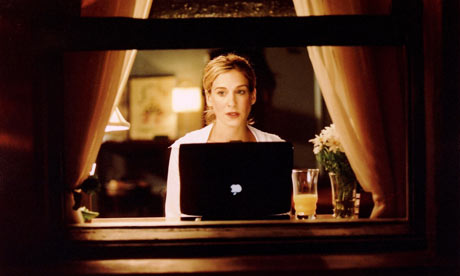
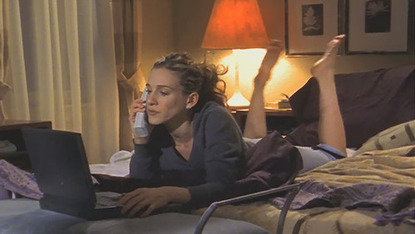
Bold words from Colin Mitchell, writing in the excellent Los Angeles theater blog Bitter Lemon. It is a well-worth-reading long rant against what one of his fellow writers, in an otherwise incoherent column, called "the sin of Nice Guyism." Though I applaud Mitchell's attitude, something about the complaint leaves me cold. It made me wonder—and I feel so wonderfully Carrie Bradshaw right now, ending my lede with a rhetorical question—is it ever nice...to be nice?

(An aside: there are so many wonderful pictures of Carrie looking thoughtful while asking inane rhetorical questions:

​My friends and I used to play a game called Carrieism, where we would try to think of the most perfectly thoughtful stupid puns. My all-time favorite, imagined for an episode about the pressures of planning an anniversary—"And so it made me wonder...at what point does a milestone...become a millstone?" Send $45 to this blog and I'll teach you how to play at home.)

Toxic reviews, are as irresistible as fried food, but Mitchell isn't calling for nastiness—just good, honest criticism. Theater criticism is not the same as writing about film, books or art. It's more like music writing—bigger and smaller at the same time—and there are a couple of reasons to argue against honesty. I'm not sure I entirely agree with them, but it seems worthwhile to raise, if only because I've got most of a cup of coffee left, and I can't enjoy coffee if I'm not typing half-witted nonsense at the same time.

The first is a question of column inches. Dozens of shows open every week, and even the Times—New York or L.A.—can cover only a handful. Savage reviews are delightful, but unless a show is a notable flop, the space can be better used. Why waste the paper's space and the reader's time on a show that's not worth the ink?

The slightly squishier argument is that, in some cases, it's better not to kick a production while it's down. At first glance, the thought of a critic refusing to speak out on behalf of the audience seems cowardly. In taking down an overblown Broadway show, the critic is, uh, whatshisname. That short guy that threw that rock at that big guy. But step down the ladder a few ranks, and suddenly Whoosewhatsit Shortguy looks pretty goddamned big. 

I'm not talking about amateur theater, although writing this did remind me of David Sedaris' vicious reviews of children's Christmas plays—"The story of the first Christmas is an overrated clunker of a holiday pageant." Small-scale theater in New York, and I say this as someone who writes for small-scale theaters, is mostly garbage. To indulge in a cliche, because I'm not getting paid to write better than this, when searching for diamonds in the rough, a critic shouldn't complain when he doesn't find a jewel. A salary, health insurance, and a full set of teeth make a professional critic a fat cat compared to most people who work off off Broadway. Tearing down their work would make him a bully.

Again, I'm not entirely sure I agree with the argument for kindness, unless it's my own work that's being reviewed. Even as I type this, I can think of one good reason to savage the smallest production: a lazy script. Last year I saw an acquaintance's play performed at a well-respected small downtown theater. The production was simple but gorgeous; the acting was mostly good; the seats were comfortable. But the script was repetitive, shrill and trite. That's not a crime—plenty of my best friends are repetitive, shrill and trite—but the playwright had spent over a year on this play, workshopping it several times and changing almost nothing at all

Present a play in good faith, and the critic owes you the benefit of the doubt. But if your playwright—or director, actor, designer—isn't capable of self-criticism, he is wasting the audience's time, and deserves a taste of the ax. 

The Case of the Missing Novel: James M. Cain’s Lost Novel Finally Surfaces After 35 Years

109-thecocktailwaitress-fixed.jpg

Oh dear, I do love James M. Cain. And I'm pretty fond of Charles Ardai and Hard Case Crime. Here's a story from September, when Ardai released a previously unpublished Cain novelThe Cocktail Waitress.

At the end of chapter two of James M. Cain’s The Postman Always Rings Twice—published in 1934, the same year the Hays Code sanitized Hollywood—a drifter takes a job at a gas station and sees the owner’s wife for the first time. The two find themselves alone for a few minutes. He kisses her, and she begs him—“Bite me! Bite me!”
“I bit her. I sunk my teeth into her lips so deep I could feel the blood spurt into my mouth. It was running down her neck when I carried her upstairs.” What took the Twilight saga 1,700 pages, Cain got to in eleven.
A failed opera singer turned journalist, Cain became infamous for novels like Postman, Double Indemnity and Serenade, where raw lust compels ordinary people to commit extraordinary crimes. By 1950, his best work was behind him, and he spent the next three decades sliding into obscurity. He died in 1977, so alone that he bequeathed his estate to his landlady.